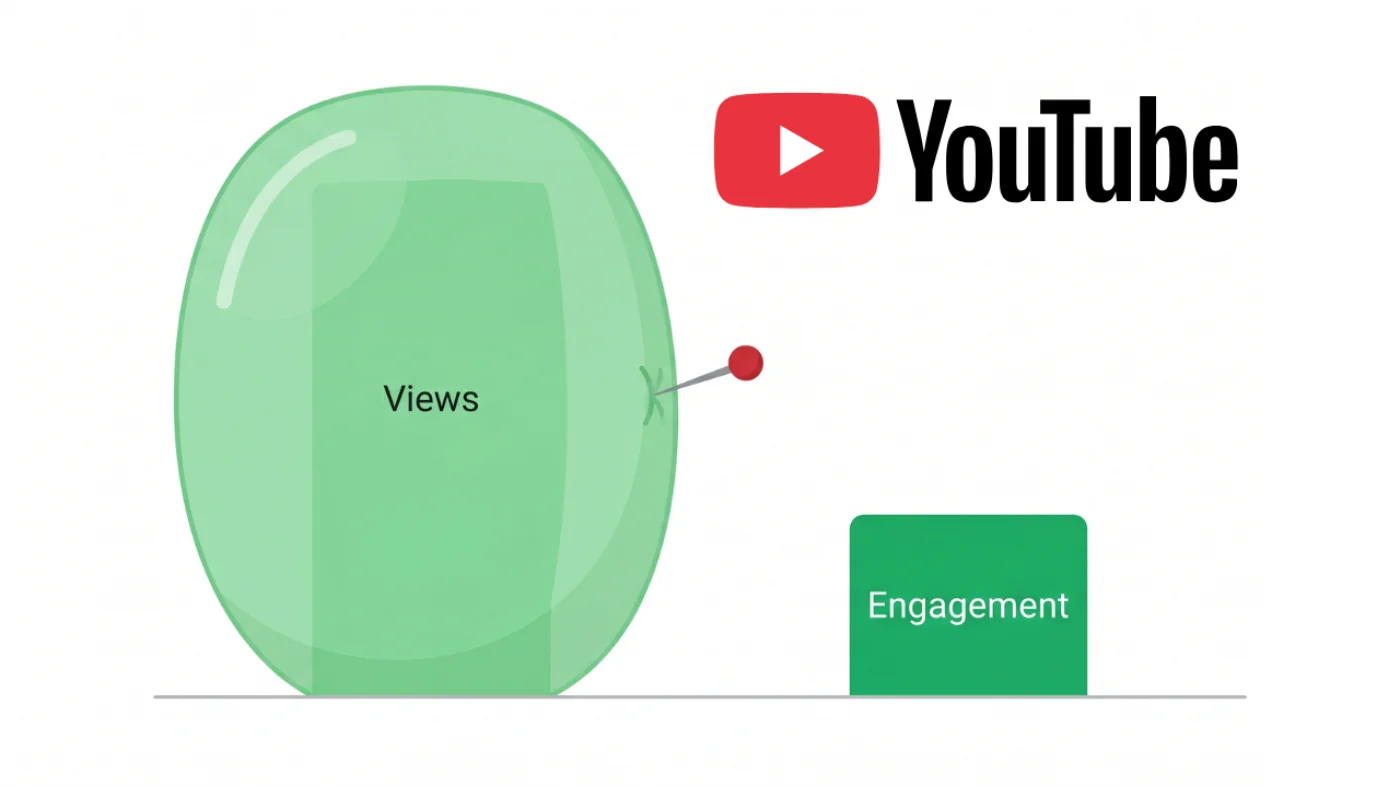
I've been on YouTube for almost ten years. During that time, Kaffeemacher has published over 750 videos. We've grown organically to 133,000 subscribers. When you've been at it that long, you learn to read the numbers. And you notice quickly when they don't add up.
What you can measure
YouTube makes three metrics publicly visible: views, likes and comments. (YouTube hid dislikes in 2021; likes remain visible to everyone.) On top of that, tools like Social Blade track subscriber growth, daily views and growth rates.
From these numbers, two ratios can be calculated that reveal a lot about a channel:
The like rate: likes divided by views. For organic channels in niches like coffee, this typically falls between 2 and 5 percent.
The comment rate: comments divided by views. The normal range is 0.1 to 0.5 percent.
These ranges aren't theory. They can be verified on any organically grown channel.
Warning levels at a glance
| Like rate | Assessment |
|---|---|
| 2–8% | Normal range for niche channels |
| 1–2% | Lower end, but still plausible |
| 0.5–1% | Unusually low, worth a closer look |
| 0.1–0.5% | Suspicious, hard to explain organically |
| below 0.1% | Virtually impossible with a real audience |
| Comment rate | Assessment |
|---|---|
| 0.3–1% | Highly engaged community |
| 0.1–0.3% | Normal range |
| 0.05–0.1% | Lower end |
| below 0.05% | Warning sign |
| below 0.01% | No real audience |
This scale doesn't come from a single sample. It emerges when you run the numbers on a few dozen niche channels. The values are consistent regardless of whether a channel has 2,000 or 130,000 subscribers.
The normal range
Before I get to the anomalies, I want to show what normal numbers look like. I looked at nine channels I've been following for years. From Coffeeness (75,200 subscribers) to Kakadu Coffee (36,900) to coffeesomething (2,120). The range covers large channels with hundreds of thousands of monthly views down to small ones with a few thousand. The engagement numbers are still consistent:
Benchmark data from organic channels
| Channel | Subscribers | Video | Views | Likes | Comments | Like rate | Comment rate |
|---|---|---|---|---|---|---|---|
| Kaffeemacher | 133,000 | Die meisten kaufen die falsche Mühle | 35,361 | 821 | 93 | 2.32% | 0.26% |
| Kakadu Coffee | 36,900 | Café Crème ohne Mahlgrad-Anpassung | 15,390 | 386 | 21 | 2.51% | 0.14% |
| TheBaristaGame | 24,600 | Ab wann stoppt man die Zeit? | 9,688 | 787 | 26 | 8.12% | 0.27% |
| Vettore Coffee | 16,300 | Billig-Espresso unter 180 € | 12,322 | 218 | 75 | 1.77% | 0.61% |
| Welter & Welter | 13,200 | ECM Synchronika 2 | 35,395 | 420 | 57 | 1.19% | 0.16% |
| Welter & Welter | 13,200 | Gaggia Classic Up vs. Evo Pro 24 | 8,838 | 180 | 19 | 2.04% | 0.21% |
| Team Brewspire | 9,860 | Neue Technik bei Siebträgern | 8,646 | 185 | 23 | 2.14% | 0.27% |
| Baristakurs Hamburg | 4,790 | Mahlkönig E64WS | 4,150 | 98 | 31 | 2.36% | 0.75% |
| DieRöster | 2,440 | Lelit Mara X3 im Test | 4,422 | 77 | 11 | 1.74% | 0.25% |
| coffeesomething | 2,120 | Sage Oracle Jet im Test | 37,490 | 604 | 140 | 1.61% | 0.37% |
The spread: like rates between 1.19 and 8.12 percent. Comment rates between 0.14 and 0.75 percent. Nine channels, nine different sizes, all within the same corridor. That's the normal range.
Channel A: The invisible giant
Then there's a channel I've been watching for a while. According to Social Blade, it has over 100,000 subscribers and around 200 videos. That should make it one of the largest German-language coffee channels on YouTube.
Except nobody knows it. It doesn't come up in any discussion. It's never recommended in any forum. It has no community presence whatsoever. That alone is odd for a channel of this size.
A look at Social Blade provides the explanation: zero new subscribers in the last 30 days. With over 100,000 subscribers. An active channel of this size normally gains several hundred subscribers per month.
The engagement numbers for individual videos confirm the picture:
| Video | Views | Likes | Comments | Like rate | Comment rate |
|---|---|---|---|---|---|
| Video 1 (machine review) | ~105,000 | 17 | 12 | 0.016% | 0.011% |
| Video 2 (machine review) | ~76,000 | 29 | 11 | 0.04% | 0.014% |
| Latest video (3 weeks old) | ~700 | — | — | — | — |
Over 100,000 views, 17 likes. An organic channel with the same view count would be expected to have 1,000 to 5,000 likes. The discrepancy isn't subtle. It's a factor of 150.
The latest video has around 700 views after three weeks. That's more in line with the actual organic reach of this channel. Between 700 and 105,000 lies a factor of 150. With no apparent explanation.
What Social Blade shows
| Metric | Channel A | Expected (organic, 100K+ subs) |
|---|---|---|
| Subscribers | over 100,000 | — |
| New subs / 30 days | 0 | 200–500 |
| Videos | ~200 | — |
Zero new subscribers in 30 days with over 100,000 subscribers. A channel that regularly posts videos and has six-figure subscriber numbers normally grows by several hundred per month. Zero means no new audience is coming in. The subscriber count is a number, not a community.
Channel B: The split pattern
The second conspicuous channel is younger. Around 20,000 subscribers according to Social Blade, just over 200 videos.
This one shows a particularly revealing pattern, because organic and presumably promoted videos can be directly compared.
The direct comparison
| Video | Views | Likes | Comments | Like rate | Comment rate | Assessment |
|---|---|---|---|---|---|---|
| Video X (machine review) | ~102,000 | 92 | 2 | 0.09% | 0.002% | ⚠️ suspicious |
| Video Y (product review) | ~2,900 | 62 | 15 | 2.15% | 0.52% | ✅ normal |
Two videos, same channel, same time period. Video Y is squarely in the normal range. Video X is off by a factor of 24 on the like rate and a factor of 260 on the comment rate.
The organic reach of this channel sits at a few thousand views per video. The outliers with five- and six-figure view counts all show the same pattern: high views, almost no engagement. Here's the distribution:
Views vs. like rate for Channel B
| Video type | Views (range) | Like rate (range) | Number of videos |
|---|---|---|---|
| Organic videos | 1,000–5,000 | 1.5–2.5% | Majority |
| Outlier videos | 38,000–165,000 | 0.05–0.15% | A few |
The split pattern is the strongest evidence. When a channel's smaller videos have normal engagement rates and only the large outliers don't, there is no organic explanation for that.
What's going on?
Two explanations come into question.
First: the videos are promoted with a budget, but the targeting is wrong. YouTube Ads can deliver views, but when the ad is served to people who have no interest in espresso machines, they don't click like and they don't leave a comment. They watch a few seconds and scroll on.
Second: views are purchased directly. There are services that deliver views cheaply, usually from click farms. Engagement is then practically zero.
In both cases, the effect is the same: high view counts without a real audience.
Why this is a problem
In the short term, the strategy works. Manufacturers look at view counts and are happy to provide a machine for review if 100,000 views are on the table. That's understandable. Very few check like and comment rates.
In the long term, it hurts everyone involved. The YouTube algorithm learns from engagement. When promoted videos generate views but no watch time and no engagement, the algorithm downgrades the channel overall. The non-promoted videos then get even less distribution. A downward spiral.
And for the community, it creates a distorted picture. When a channel with 100,000 subscribers and regularly six-figure view counts is used as a reference point, it devalues the honest work of channels that reach an engaged audience with 5,000 or 20,000 views.
How to check it yourself
The data is public. Here's how:
- Go to any YouTube video and look at the views and likes. Divide the likes by the views. Below 1 percent is unusual. Below 0.5 percent is suspicious. Below 0.1 percent is almost impossible to explain with organic traffic.
- Scroll down to the comments. YouTube shows the count right above the comment field. Calculate: comments divided by views. Below 0.05 percent on a niche channel is a warning sign.
- Go to socialblade.com and enter the channel name. There you can see the subscriber trend over the last 30 days. An "active" channel with 100,000 subscribers and zero new subscribers per month did not grow organically.
- Compare multiple videos from the same channel. If most videos have a few thousand views and individual videos suddenly jump to 100,000 without the like rate following along, that's a strong indicator.
The positive examples
I deliberately didn't name the suspicious channels. That's not the point of this post. The point is that the numbers can be read if you know what to look for.
Instead, I want to name the channels that have been enriching coffee YouTube week after week for years. The list isn't complete, but it shows how consistent engagement numbers are across organic channels, regardless of size.
Coffeeness (75,200 subscribers, 405 videos) has been producing consistently good machine reviews, especially of super-automatic espresso machines, with stable growth for years. Kakadu Coffee (36,900 subscribers) specializes in latte art and portafilter basics. Inactive for a while, but now posting more frequently again. TheBaristaGame (24,600 subscribers) delivers the highest like rate in this lineup at 8.12 percent. Vettore Coffee (16,300 subscribers) is growing fastest at +400 subscribers per month. Welter & Welter (13,200 subscribers) have been doing machine reviews from Cologne since 2014. Team Brewspire (9,860 subscribers, 390 videos) posts every week. Baristakurs Hamburg (4,790 subscribers) delivers the highest comment rates and enriches the coffee world with machine reviews. DieRöster (2,440 subscribers) test from Austria. coffeesomething (2,120 subscribers) shows that even small channels can have strong engagement.
The specific numbers are in the tables above. What they all have in common: like rates between 1 and 8 percent, comment rates between 0.1 and 0.75 percent. That holds regardless of channel size.
Social Blade: Growth of positive channels (last 30 days)
| Channel | Subscribers | New subs / 30d | Views / 30d | Total videos |
|---|---|---|---|---|
| Coffeeness | 75,200 | +300 | 263,000 | 405 |
| Team Brewspire | 9,860 | +500 | 89,000 | 390 |
| Vettore Coffee | 16,300 | +400 | 195,000 | 420 |
| Baristakurs Hamburg | 4,790 | +300 | 23,000 | 91 |
| Welter & Welter | 13,200 | +300 | 56,000 | 175 |
| Kakadu Coffee | 36,900 | +200 | 51,000 | 123 |
| TheBaristaGame | 24,600 | +100 | 56,000 | 164 |
| DieRöster | 2,440 | +70 | 26,000 | 218 |
| coffeesomething | 2,120 | +20 | 14,000 | 59 |
For comparison: Channel A, with over 100,000 subscribers, gained zero new subscribers in the same period.
Organic vs. suspicious: The factor comparison
When you put the averages of all analyzed channels side by side, the scale of the deviation becomes visible.
| Metric | Organic (avg. 9 channels) | Suspicious (avg. 3 videos) | Factor |
|---|---|---|---|
| Like rate | 2.58% | 0.05% | 52× |
| Comment rate | 0.33% | 0.009% | 37× |
The suspicious videos have, on average, a 52 times lower like rate and a 37 times lower comment rate than organic videos in the same niche. This isn't a grey area. It's a different category.
Coffee YouTube is getting better. Because of the people who put in the work to build a real audience. Not because of those who buy views.
Data basis: Own survey, April 2026. Engagement data collected directly on YouTube. Subscriber and growth data via Social Blade. All figures are snapshots at the time of analysis.
Comments